Research Interests
My main research interests lay in the field of theoretical syntax. My current work–approached from a minimalist and biolinguistics perspective–centers around my interest in the syntactic size of objects. The work in my dissertation centers around the phenomenon of adjunct control, the study of null subjects of non-finite clauses, and the syntax of the VoiceP edge. I present a novel observation of an undiscussed type of adjunct control structure involving pronominal clitics controlling into Voice’ adjuncts that, I argue, challenges an established generalization regarding the licensing of control. The study of these structures results in theoretical implications surrounding a traditionally difficult question regarding the positions of multiple specifiers in the verbal domain (Voice), for which I propose a relationship between the size of a DP and its phase-edge position. Extending beyond specifiers and control, my current research program also encompasses work on other “smaller” syntactic elements, including one project looking at patterns of comparative morphology found within different classes of anticausative verbs in Polish, and a new project looking at the syntax of wh-complement constructions, including free relatives and indirect interrogatives. With this work, I am particularly interested in the structure of PP free relative clauses in Spanish, and the size of the wh-element, in order to understand how these can be analyzed under a labeling framework.
Publications
VanDyne, Katie. (2024). Examining the theoretical contradiction of Merge-over-Move and Merge. Proceedings of the 59th Annual Meeting of the Chicago Linguistics Society.
VanDyne, Katie & Jonathan E. MacDonald. (2024). Control in Romanian and Se constructions. RLLT 21, eds. Grant Armstrong, Roberta D’Alessandro & M.Carmen Parafita Couto. Special Issue of Isogloss. Open Journal of Romance Linguistics 10(2)/4, 1-24. https://doi.org/10.5565/rev/isogloss.260
Dees, Joshua A., Katie VanDyne & Anna Romaniuk. (2024). The C△G and Polish causative/anticausative deadjectival verbs. Proceedings of the Linguistic Society of America, 9(1), 5698. https://doi.org/10.3765/plsa.v9i1.5698
VanDyne, Katie. (2022). Object control into temporal adjuncts: the case of Spanish clitics. In Bullock, Barbara E.,Russi, Cinzia & Toribio, Almeida Jacqueline (eds.), A half century of Romance linguistics: Selected proceedings of the 50th Linguistic Symposium on Romance Languages. (Open Romance Linguistics 2) Berlin: Language Science Press.
VanDyne, Katie. (2020). The interaction of adjunct control and parasitic gaps in Spanish. In J. Colomina-Almiñana and S. Sessarego (Eds.), Language patterns in Spanish and beyond: Structure, context and development. Routledge
Fellowships
Dissertation Completion Fellowship, UIUC School of Literatures Cultures and Linguistics (2023-2024)
Timothy J. Rogers Memorial Fellowship, UIUC Department of Spanish & Portuguese (2023)
Summer Research Fellowship, UIUC Department of Spanish & Portuguese (2019)
Foreign Language Area Studies (FLAS) Academic Year Fellowship to study Quechua, US Department of Education/ UIUC Center for Latin American and Caribbean Studies (2017-2018)
Summer Research Fellowship, UIUC Department of Spanish & Portuguese (2017)
conference Presentations
VanDyne, Katie. (2025). Wh‑objects and the Form Copy theory of adjunct control. Chicago Linguistic Society 61 (CLS). University of Chicago
Dees, Joshua & Katie VanDyne. (2025). Pseudo‑ABA patterns in Polish deadjectival change‑of‑state verbs. Chicago Linguistic Society 61 (CLS). University of Chicago. (Poster)
Dees, Joshua & Katie VanDyne. (2025). Spanning, Portmanteau, and Spell‑Out: The C∆G and pseudo‑ABA patterns. Generative Linguistics of the Old World 47 (GLOW). Frankfurt, Germany. (Poster presented by Joshua Dees)
VanDyne, Katie. (2024). A unified syntactic analysis of three Spanish wh-complement constructions: head movement and the labeling algorithm, Hispanic Linguistics Symposium (HLS). October 17-19, 2024. Omaha, NE.
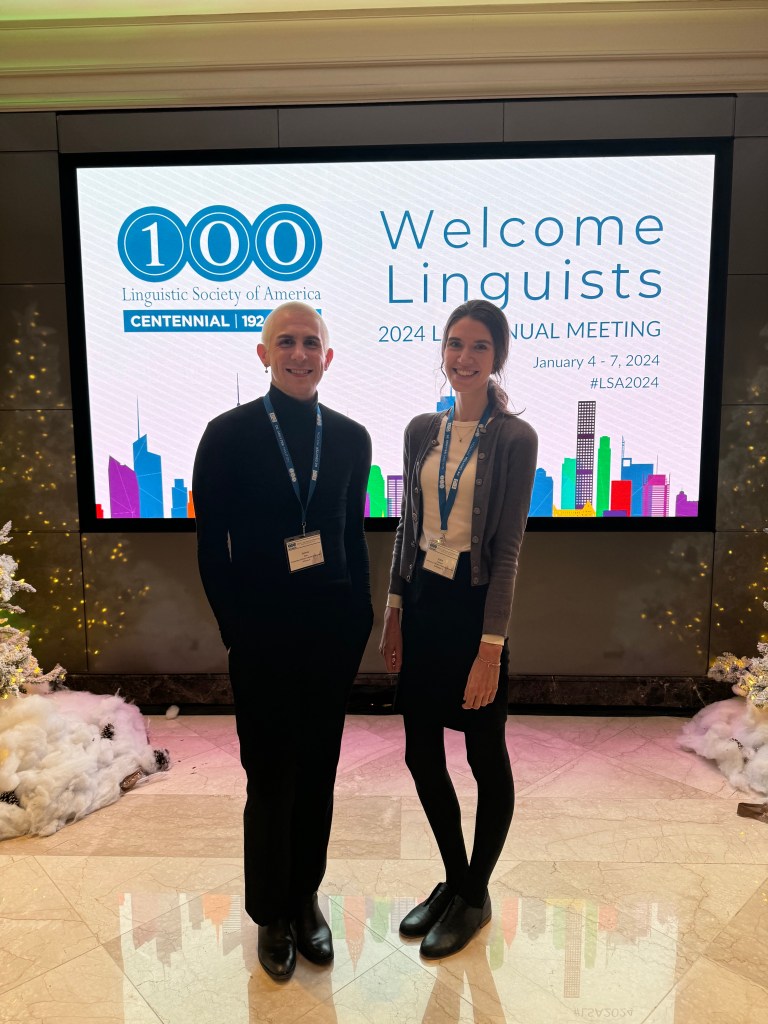
VanDyne, Katie. (2024). Relating the size and the specifier: Contrasts in intermediate wh-movement, Linguistic Society of America (LSA) Annual Meeting. January 4-7, 2024. New York, NY.
Dees, Joshua, Katie VanDyne & Anna Romaniuk. (2024). The CΔG and Polish causative/anticausative deadjectival verbs. Linguistic Society of America (LSA) Annual Meeting. January 4-7, 2024. New York, NY.
Dees, Joshua, Katie VanDyne & Anna Romaniuk. (2023). For better or for worse: An analysis of allomorphic variation in Polish anticausative deadjectival verbs. Western Conference on Linguistics (WECOL), November 11‑12, 2023. California State University, Fresno (online).
VanDyne, Katie. (2023). Examining the theoretical contradiction of Merge-over-Move and MERGE, Chicago Linguistics Society (CLS), April 28-30, 2023. Chicago, IL.
VanDyne, Katie. (2023). On the structural differences between shifted objects and clitic movement in Spanish. Linguistic Society of America (LSA) Annual Meeting, January 7, 2023. Denver, CO. (Poster)
VanDyne, Katie. (2022). Isolating the vP positions of Spanish proclitics and shifted objects Hispanic Linguistics Symposium (HLS) , November 5, 2022. Arizona State University (online)
VanDyne, Katie and Jonathan E. MacDonald (2022) Control in Romanian and se constructions. Linguistic Symposium on Romance Languages (LSRL) , April 23, 2022. UW-Madison (online)
VanDyne, Katie. (2020) Optionality in Spanish clitic positions: Observations from control Going Romance, November 27, 2020. Paris (online)
VanDyne, Katie. (2020). Adjunct control by object clitics in Spanish: an argument against control as movement, Linguistic Symposium on Romance Languages (LSRL), July 3, 2020. UT-Austin (online)
VanDyne, Katie. (2018). The interaction of adjunct control and parasitic gaps in Spanish, Hispanic Linguistics Symposium (HLS), October 25, 2018. UT-Austin
VanDyne, Katie. (2017). Passive parasitic gaps in Spanish, Hispanic Linguistics Symposium (HLS), October 26, 2017. Texas Tech University

 Katie VanDyne